
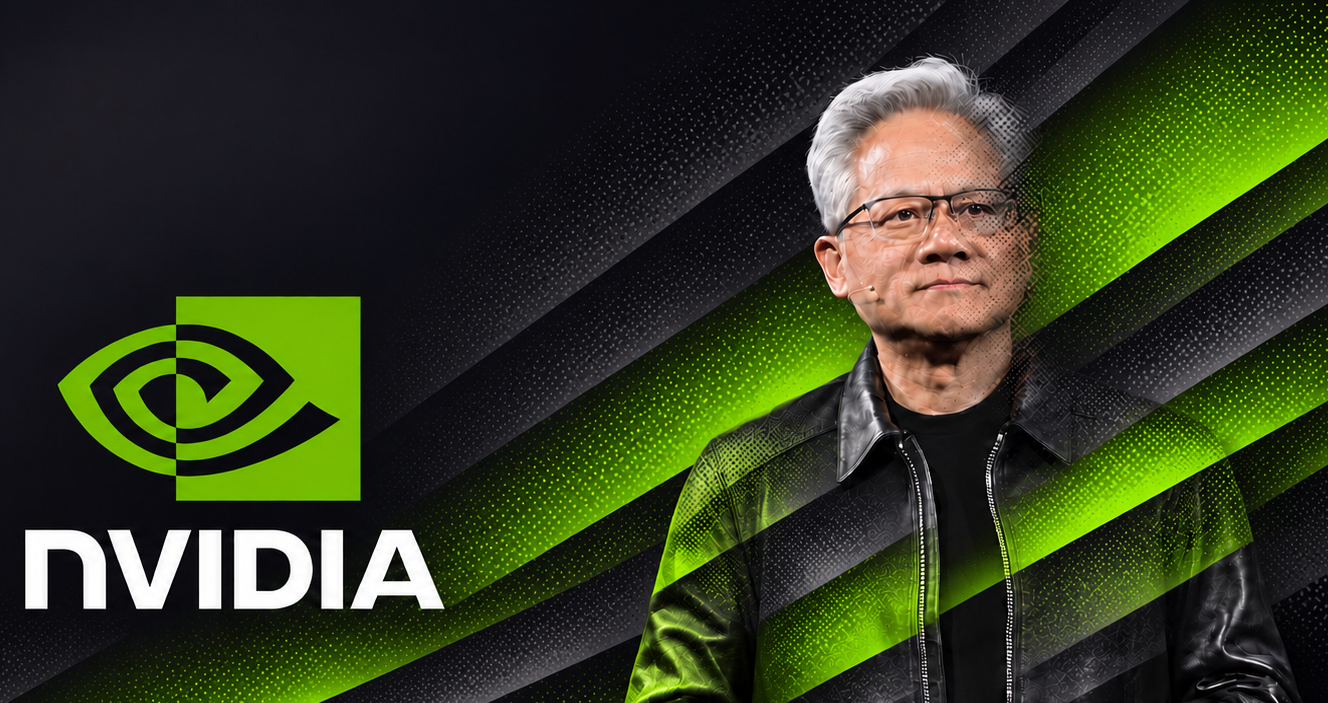
NVIDIA (Nasdaq: NVDA) has reinstated co-founder Jensen Huang as president, chief executive officer and a member of its board, restoring the leadership structure that has guided the company through the buildout of enterprise AI infrastructure. The unanimous board decision takes effect immediately and returns Huang to the center of decisions affecting a supplier whose accelerated-computing platforms underpin many data-center expansion plans.
Investors reacted sharply to the move. NVIDIA shares closed Nov. 23 up 31.48% at $165.05, from $125.53 at the prior close, according to market reports. The gain added roughly $950 billion in market value in one session. The broader technology market had begun recovering before NVIDIA disclosed Huang’s return, so the full move cannot be assigned solely to the board’s action. Still, the scale of the rally showed how strongly investors associate Huang with the company’s strategy and execution.
NVIDIA said its directors voted unanimously after a series of discussions and meetings with Huang, concluding that he had demonstrated the candor and leadership ability to lead the company. Harvey C. Jones, NVIDIA’s board chair, said the directors believed Huang’s reinstatement was in the best interests of the company’s shareholders, employees, partners and customers.
Huang resigned as CEO and director on Nov. 12. During the intervening transition, Executive Vice President and Chief Financial Officer Colette Kress served as interim CEO while continuing as CFO. NVIDIA said Kress will remain CFO, while Jones will continue as board chair.
For infrastructure and platform teams, the immediate significance is continuity at an important hardware and software supplier rather than a newly disclosed product change. NVIDIA did not announce revisions to its technology roadmap, capacity plans, pricing or customer commitments as part of Huang’s return. Its earlier transition statement said the leadership team expected customer commitments and the product roadmap to continue without interruption. That leaves customers with continuity in top leadership, but not a substitute for their usual product, supply and procurement validation.
That distinction matters for organizations that are budgeting for GPU capacity, AI model training, inference systems, data-center networking and related software. The return restores a familiar executive point of accountability for a supplier that can influence those plans, but it does not by itself create additional compute capacity or change an enterprise’s deployment requirements. Customers will still need to assess availability, workload demand, cost and operational controls for their own environments.
The board’s governance measures also remain in place. NVIDIA said an independent-director committee will continue its investigation into reporting that Huang was targeted by a foreign intelligence effort. The company has also established a National Security and Export Control Committee composed of independent directors and is seeking a chief compliance officer to oversee companywide compliance.
The market response does not settle those governance questions. It does, however, highlight the weight investors place on leadership continuity at a company central to the AI infrastructure market. For enterprise IT leaders, the practical near-term takeaway is a return to the management structure that has overseen NVIDIA’s product and platform direction, alongside increased board-level scrutiny of compliance and national-security risks.