


IT Automation Week has named simplyblock a Top Product of the Week for its built-in disaster recovery for OpenShift Virtualization. The designation recognizes the company’s effort to combine storage replication, recovery orchestration, workload mobility and backup in one software-defined storage platform, rather than requiring teams to license a separate disaster-recovery product.
According to Simplyblock CEO Rob Pankow, the platform supports OpenShift 4, including OpenShift Virtualization deployments. It integrates through the Simplyblock Operator and CSI driver and is listed as a certified containerized application in the Red Hat Ecosystem Catalog.
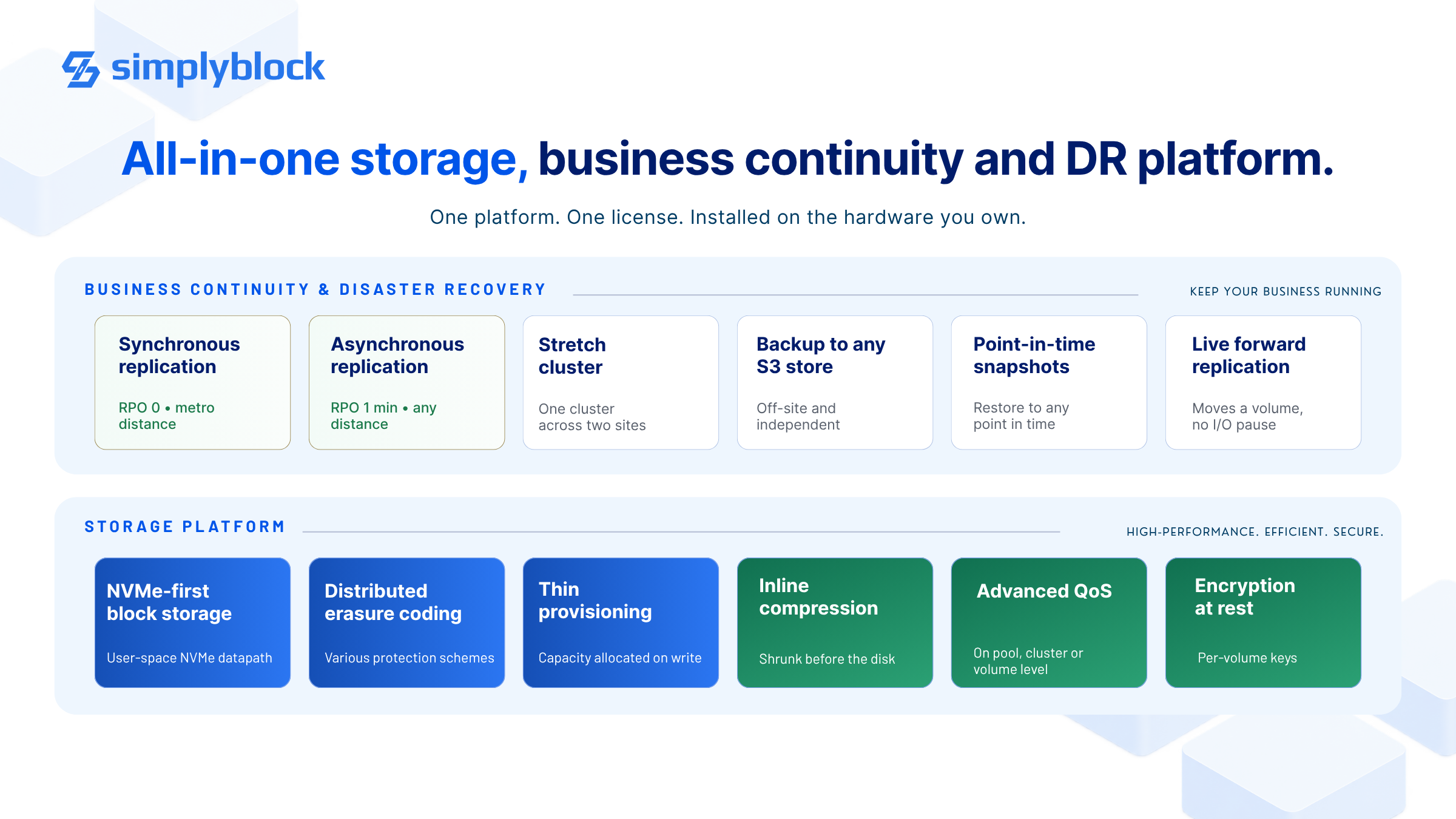
The launch expands protection beyond individual storage volumes to cover individual virtual machines, VM groups and consistency groups. A consistency group can create coordinated crash-consistent recovery points across related volumes. Application-consistent recovery, however, depends on a guest operating system or application properly quiescing writes, Pankow said. Boot order and failover sequencing across protection groups are separate orchestration functions, an important distinction for organizations recovering multi-tier applications.
The product offers synchronous replication for supported stretch-cluster designs and asynchronous replication for other recovery scenarios. In a synchronous configuration, storage-path failover can retain access to data through a supported site failure with a recovery point objective of zero, according to Pankow. If compute resources are also lost, the overall recovery-time objective includes VM restart, application recovery, boot time and sequencing. The company does not state a universal application RTO, which must be established through testing for the customer’s topology and workloads.
For asynchronous recovery, the company said the failover decision, activation of replicated data and workload restart are the main contributors to recovery time. Its orchestration tools add boot sequencing and isolated disaster-recovery testing to help teams run and validate that process. The previously cited one-minute figure is the minimum asynchronous replication interval and can support an RPO of about one minute, subject to replication lag; it is not a blanket one-minute recovery-time commitment.
Administrators can use the Simplyblock Operator API through standard Kubernetes and OpenShift tooling, making the functions available to automation workflows. The company also provides a user interface covering most API functions, including planned failover and failover testing. Pankow said the platform uses upstream ecosystem components such as OCM and Ramen internally, rather than exposing them as user-facing interfaces.
The behavior during an inter-site link failure varies by replication method. In asynchronous mode, new recovery points stop reaching the secondary site, causing the replication lag and potential RPO to grow. The last completed replica remains available, while the secondary stays read-only until an operator explicitly requests failover. In synchronous replication, the volumes continue operating in isolation and automatically resynchronize the delta when the link returns, according to Pankow. The platform monitors replication health, failover and failback readiness, and current RPO in real time for both methods.
Simplyblock said its design prevents conflicting writes by keeping recovery-site volumes read-only until they are promoted; a centrally coordinated arbiter handles the promotion and demotion process. Both sites may be active, but they must serve distinct volumes and workloads. Those controls aim to reduce the risk of data inconsistency or split-brain conditions, though customers will still need to test their procedures, failure domains and application dependencies.
Source and recovery clusters can use different supported hardware configurations, and the company said supported cloud and on-premises designs are possible when the sites meet capacity, performance, connectivity and control-plane requirements. The recovery hub must run a version equal to or newer than the site clusters. That flexibility could matter to organizations using disaster recovery during a hardware refresh or when maintaining different infrastructure at a secondary site.
Simplyblock Enterprise is sold as a subscription priced by the number of OpenShift worker nodes; control-plane and infrastructure nodes are excluded, Pankow said. Replication, VM- and container-level disaster-recovery orchestration, and related DR capabilities are included without a separate Simplyblock DR feature surcharge. Customers must still budget for their own site infrastructure, connectivity and backup storage, while final commercial terms are quoted for the deployment.
IT Automation Week selected Simplyblock as a Top Product of the Week for the combined replication, mobility and backup capabilities. The technical advantages underscore the product’s ability to give OpenShift Virtualization teams a unified storage-level control plane for planned changes and recovery operations, while leaving them responsible for validating application behavior and recovery objectives in their own environments.