
Enterprises leaving VMware, a Broadcom (NASDAQ: AVGO) business, or Nutanix (NASDAQ: NTNX) can find that moving an application is only one part of the transition. Storage, networking, VM mobility, backup, recovery and the procedures IT teams use every day may all have been built around the former virtualization environment. The result is a migration challenge that extends beyond choosing a new hypervisor.
simplyblock has received certification for its Container Storage Interface driver and Operator on Red Hat, an IBM (NYSE: IBM) company, OpenShift. The software is listed in the Red Hat Ecosystem Catalog. Simplyblock is positioning the certification, together with its business-continuity and disaster-recovery capabilities, as a storage blueprint for organizations moving VM workloads to Red Hat OpenShift Virtualization.
In a Q&A with IT Automation Week, Simplyblock CEO Rob Pankow said the transition can begin on eligible hardware customers already own. He said a hyperconverged deployment and efficient storage use can support a proof of concept and staged migration without an immediate purchase of a new storage array or replacement server estate. Existing applications can remain in VMs while new containerized applications use the same storage foundation, he said.
Simplyblock is a Kubernetes-native distributed block-storage system that serves VMs and containerized applications through one storage layer. Teams provision storage through standard Kubernetes interfaces and manage it with the Simplyblock Operator. The platform includes erasure coding, thin provisioning, copy-on-write snapshots and clones, quality-of-service controls and volume encryption. Capacity scales by adding nodes, according to the company.
Pankow said customers can retain many outcomes they rely on in a VMware environment, including running existing applications in VMs, provisioning persistent storage, moving supported VMs between hosts, and protecting and recovering data. The operating model changes, however: teams use OpenShift’s console, APIs, Operators and policies, and must validate equivalent networking, backup and recovery procedures. The relevant test is whether the new environment meets application service levels and makes daily operations manageable, he said, rather than whether every workflow resembles vCenter.
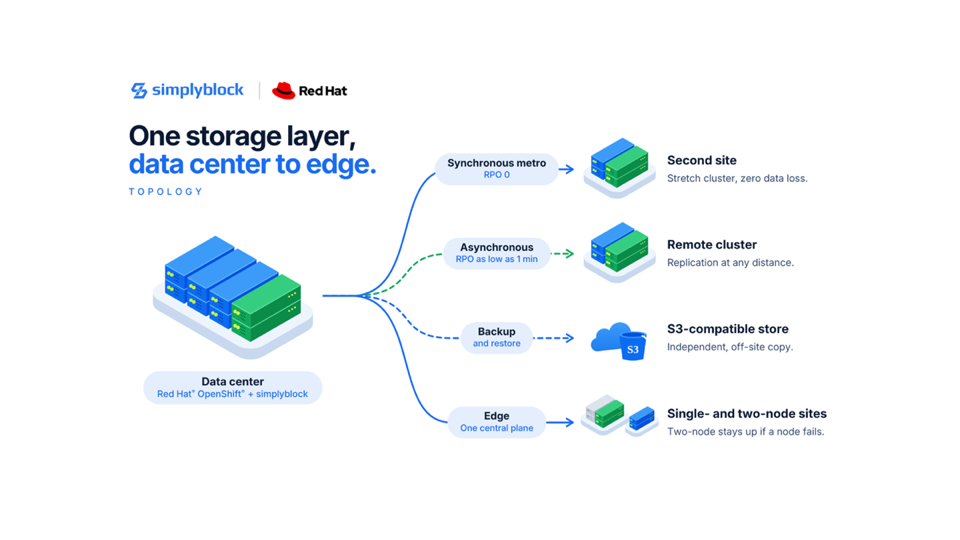
The company’s recovery functions include synchronous metro replication with a zero recovery-point objective in a stretch-cluster configuration, asynchronous replication with recovery-point objectives as low as one minute, and snapshots backed up to S3-compatible storage. When recovery is needed, Pankow said, a team selects a protected copy or recovery point, initiates failover or restore, and brings workloads online using its configured network mappings and startup order. Restore time also depends on data transfer, VM startup and application dependencies.
The financial case should include more than software subscriptions, Pankow said. He said customers typically save at least 50% of prior total cost of ownership, but that is a company claim rather than an independently verified result. A complete comparison should include hardware, networking, recovery-site capacity, backup storage, support, ongoing operations, training, migration work and the period when both environments run. Simplyblock said server reuse, efficient storage protection and built-in recovery can reduce separate storage and disaster-recovery product requirements.
Support remains divided by product boundary. Red Hat supports OpenShift and OpenShift Virtualization, while Simplyblock supports its storage platform, CSI driver, Operator and data-protection functions. Pankow said an initial investigation should identify whether an issue resides in the platform, storage layer or their interaction, with logs and reproduction details shared as needed. For IT organizations, the certification adds a defined storage and recovery option, but a sound migration still requires service-level validation, recovery testing and clear vendor-support responsibilities.